Event 1
Second World War
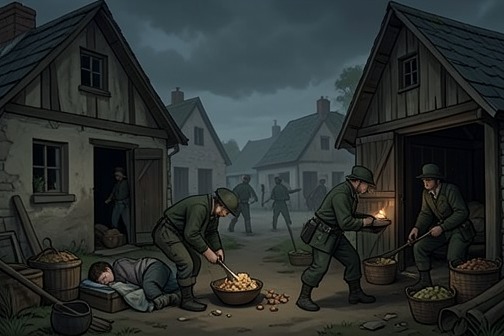
The [Second World War](entity:event-recall-event-7e5722c923de) is rendered as a condition that reaches far beyond the battlefield: it determines where a child can sleep, whom he can trust, and what a village chooses to see. In the novel’s account of occupied [Eastern Europe](entity:location-recall-location-eastern-europe-304a0e697562), the unnamed boy narrator moves through danger as German forces search for partisans, take supplies, and transport Jewish and Roma people toward their deaths. The Afterword then sets these fictional scenes beside testimony and wartime documents, while explaining why the author turned to fiction to confront experiences that political assurances and conventional accounts of peace could not contain.
## Occupation and the Boy’s Precarious Shelter
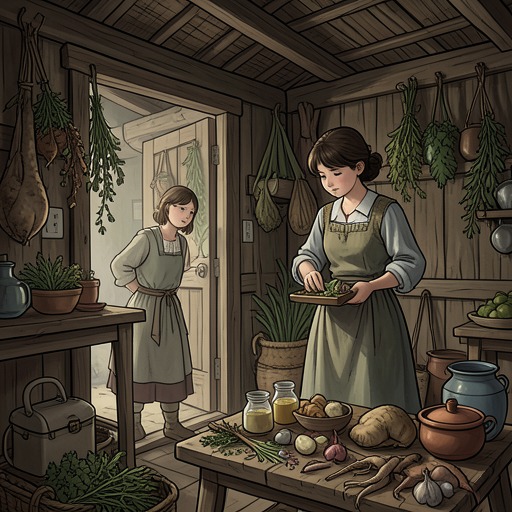
After several days in the woods, hungry and exhausted, the boy approaches a village and offers a farmer his labor in exchange for food and a place to sleep. The farmer has no children; his wife agrees to take the boy in after speaking with neighbors. He sleeps in the stable and works for the household. The village is poor, and [German soldiers](entity:character-recall-character-german-soldiers-00e4e09725f6) arriving from a nearby railroad station take whatever food they can find. The war therefore appears not only as a distant military campaign but as an intrusion into ordinary subsistence and the fragile arrangement that keeps the boy sheltered.
When German soldiers approach, the farmer hides him in a concealed cellar beneath the barn. [The boy](entity:character-recall-character-the-boy-c36ba9027348) helped dig it, and only the farmer and his wife know where it is. Its narrow entrance and depth make it a refuge while soldiers search the house and surrounding fields for food. He waits below until their trucks leave, then returns to his duties. The episode makes survival depend on a practical secret and on the farmer’s willingness to protect him, while also showing how quickly that protection could be tested.
As detachments search the surrounding forests and enforce compulsory deliveries, the farmer warns the boy that a raid is coming. The Germans have learned that a Jewish man has been hidden in a village. The farmer orders the boy to flee into the forest that night. This news brings the threat close to the household: the boy’s continued presence risks discovery, and shelter gives way to flight. His movement through the war is shaped by repeated, temporary refuge rather than a safe destination.
## Deportation and the Village as Witness
The railroad brings another dimension of the war into the villagers’ daily lives. The boy sees trains carrying Jewish and Roma people in locked cattle cars; reports from people connected to a nearby concentration camp describe the separation of those arriving and the taking of their possessions. The account presents these as events the villagers hear about and observe, not as the boy’s direct experience inside the camp. Their knowledge does not produce solidarity. Instead, many interpret the deportations through antisemitic religious beliefs and treat the persecution as deserved.
When villagers direct hostility toward the boy because of his dark features and presumed identity, his danger increases even in places beyond the immediate reach of German forces. The narrative connects the racialized categories used to persecute people with the boy’s own uncertain sense of where he belongs. His appearance makes him vulnerable to others’ suspicion, while his questions about the difference between Jewish and Roma identity register how arbitrary and threatening those distinctions have become in his world.
The people beside the tracks are not merely passive witnesses. Villagers gather to watch deportation trains pass and gesture toward them; the people inside may mistake those gestures for a welcome. The scene places public curiosity and apparent friendliness beside the prisoners’ isolation. Elsewhere, when the villagers search near the railway after several trains have passed, they find a young child who has fallen from one of them. They do not take him into care: after he dies, they remove his clothing and leave his body where a German patrol will find it. The incident makes the civilian response part of the landscape of wartime violence, without equating that response with the organized machinery of persecution.
The aftermath of the trains continues along the tracks. The boy finds human ash and fears that the dead will remain with him as ghosts. That fear gives the material traces of mass death a private afterlife in his imagination. The narrative thus moves from what can be observed—the trains, the scattered remains, the abandoned personal effects—to the child’s effort to comprehend deaths that cannot be made ordinary by the villagers’ explanations or rituals.
## Retreat and the Changing Front
For a time, the boy’s surroundings offer only uncertain predictions about the war’s course. A distant exchange of gunfire leads villagers to argue about whether the front is approaching and whether the Germans are losing. Their expectations are divided: some hope the Soviet authorities will redistribute land, while others fear the suppression of religion and private life. The boy listens from his vulnerable position, trying to imagine whether he might be treated as a child and allowed a place in the new order. These arguments show that military change is also anticipated as a change in who will hold power over village life.
The shift becomes visible at the guarded railroad bridge. German soldiers dismantle its weapons and lower the flag; their trucks move west, and villagers conclude that German forces are retreating. The following day, a mounted force arrives. The villagers recognize the riders as [Kalmyk cavalrymen](entity:character-recall-character-f0f4862e50b4) and react with fear, shaped by stories that have circulated about their service alongside the Germans. The sequence contrasts rumor and immediate observation: the withdrawal of German forces is tangible, but the arrival of another armed group does not make the village feel secure.
By autumn 1944, the boy has been released from a regimental hospital after the injury that sent him there has healed. Contrary to his fear, the soldiers allow him to stay, although he understands that this arrangement may end when the regiment moves toward the front. It is a young communications regiment with new equipment, and the front has already moved far away into enemy territory. Radio reports describe German defeats; letters and newspapers bring news of reconstruction and ruined cities, while soldiers doubt they will see battle before the war ends. The war’s changing distance alters the boy’s immediate prospects, but it does not erase his dependence on the temporary protection of others.
## Memory, Testimony, and Fiction
In the Afterword, the author revisits the war from the perspective of later life. In 1963 he travels to [Switzerland](entity:location-recall-location-6e6c25b1c44d) with his American-born wife, who is seeking further specialist care for an illness. At a hotel populated by elderly Europeans who had escaped before the slaughter began, he is troubled by their idealized confidence in peace and by the distance between that view and what he and his parents endured. This encounter helps explain his decision to turn from social science to fiction: he believed fiction could represent lives as they were lived, rather than rely on political promises about a future that would redeem them.
The author also resists treating the novel as straightforward autobiography. He argues that the boy’s fictional life should remain independent of his own, and that a reader enters fiction differently from the way a reader observes another person’s life in autobiography. That distinction matters to the novel’s account of the Second World War: the child’s experiences are shaped into a fictional narrative, not offered as a complete documentary record of one individual’s life. The author’s refusal to make his biography the book’s proof is part of his defense of its imaginative form.
The Afterword nevertheless places the novel’s violence in conversation with historical evidence. The author notes that critics who accused the book of excess often failed to consult survivor accounts and official wartime documents. He cites testimony about the destruction of villages and the killing of civilians, and records concerning the Nazi murder of children and the deaths of Roma people in camps. These materials are distinct from the novel’s scenes: they do not turn the fiction into an archive, but they challenge the claim that its brutality was simply invented or exaggerated. The author also recalls that some former schoolmates judged the novel less severe than what they and their relatives had experienced.
The war’s meaning therefore emerges through several different forms of witness: the child’s limited, immediate perspective; the villagers’ compromised observation; the author’s retrospective explanation; and testimony and documents cited in the Afterword. The book does not collapse these forms into one account. Instead, it shows how the war persists in memory and in later arguments over who may speak, what counts as truth, and whether fictional form can bring readers closer to lives that political language and distance have obscured.
Event 2
Nazi Germany's Invasion of the Soviet Union
[Nazi Germany's Invasion of the Soviet Union](entity:event-recall-event-8942101d4f87) is not narrated in the available passage, which offers no details about the invasion, its participants, or its consequences. The passage instead records a lesson from [Gavrila](entity:character-recall-character-gavrila-ed2f51729643) about human agency and the making of history.
Event 3
The Nazi Genocide of the Romani People
[The Nazi Genocide of the Romani People](entity:event-recall-event-9d2b8aa8ab6f) is presented in [The Painted Bird](entity:expression-recall-expression-the-painted-bird-53d74c62fcb2) as part of a system of deportation and mass killing that also targeted Jews. The novel places the machinery of persecution beside the conduct of people who watched it pass, profited from its traces, or used its racial logic against a vulnerable child. Its afterword then answers accusations that the book exaggerated wartime cruelty by citing survivor testimony and camp records, distinguishing the novel’s scenes from the documents invoked to corroborate the historical violence.
## Deportation and the railway
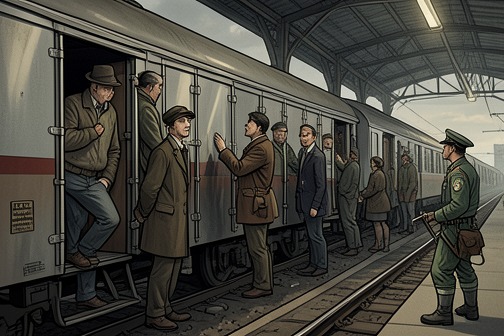
[The unnamed boy narrator](entity:character-recall-character-905a426e9322) first encounters the deportations through a new kind of train moving along the railway in the forest. Earlier trains carried freight under the surveillance of armed [German soldiers](entity:character-recall-character-german-soldiers-00e4e09725f6); now locked cattle cars carried captured Jews and Romani people toward their deaths. [The narrator](entity:character-recall-character-1ef2797e1434) hears that each car held about two hundred people, including men, women, children, and babies. The details of sorting and killing at the camps reach the village through railway workers and peasants who had been employed in camp construction, so the book separates what the boy sees from what villagers report.
The trains turn the railway into a public scene of persecution. Peasants line the tracks and wave cheerfully to the railway workers and guards. People inside the cars, visible only through small high windows, respond with desperate gestures; those outside mistake the spectacle for something less terrible, or choose to behave as though it were. The train’s passage is thus both transport and a test of the surrounding community: the victims are visible, but visibility does not produce aid. The contrast between the villagers’ greeting and the captives’ signals makes ordinary public behavior part of the scene’s moral indictment.
The narrator also encounters what the trains leave behind. When villagers search the trackside after several trains have passed, they find an unidentified child, about five years old, who appears to have fallen from a car. The people gathered around him recoil from his dark eyes and cross themselves. After he dies, they take his clothes and leave his body where a German patrol will find it. The episode does not establish the child’s identity, but its placement among accounts of the deportations shows how racial fear and self-interest shape the villagers’ response even to a helpless child.
## Persecution carried into village life
The danger of being marked by appearance is not confined to the railway. As talk of the camps spreads, villagers turn their hostility toward the unnamed boy narrator, whom they identify as Romani. They threaten him with burning and treat his dark hair and eyes as signs that he belongs among the people being persecuted. Some shepherds try to drag him toward a fire; he resists and escapes. The scene makes persecution immediate for him: the distant system of deportation becomes a local threat, enforced by people who repeat its racial categories and invoke religious approval.
In the boy’s nighttime fears, these categories become an anxious question about family and survival. He remembers his father as fair-haired and blue-eyed, while his mother was dark, and wonders what distinguishes a Romani person from a Jew when both are treated as doomed because of their appearance. He imagines a postwar world populated only by fair-haired, blue-eyed people, then asks what would happen to children born dark to such parents. The passage does not offer an abstract explanation of racial classification; it shows a child trying to understand why appearance can determine who is hunted and whether even family lineage can protect anyone.
The villagers’ response to the deportations reveals a related mechanism of persecution. They interpret the killing of Jews as divine punishment and cast the Germans as instruments of justice. This religious explanation does not describe Romani persecution in the same terms, but it helps establish the moral climate in which the boy is threatened: violence against people designated as outsiders can be accepted, rationalized, or repeated by those around them. The book therefore distinguishes the targets of the Nazi genocide while showing how antisemitic belief and anti-Roma hostility coexist in the same village world.
That world is not uniformly defined by explicit denunciation. In another episode, a farmer tells the boy to flee because German forces are preparing a raid after learning that a Jew has been hidden in a village. The community knows the man and remembers his family’s local standing, describing him as a decent person despite his Jewish identity. The warning gives the boy a chance to escape, but it also shows the precarity of such acceptance: a known neighbor can remain at risk when German forces search for someone hidden from them.
## Remains, memory, and documentary evidence
The aftermath of the trains persists along the tracks. The villagers encounter ashes and other remains, sometimes covering them with dirt because they fear contamination. The unnamed boy narrator secretly handles some of the human ash and cannot treat it as ordinary fuel residue. He fears that the dead may remain present in memory, following the living and bringing illness or madness. His response registers the limits of the villagers’ attempts to dispose of the evidence: the remains can be buried or scattered, but witnessing them changes the witness.
The railway also yields personal documents and photographs—passports, diaries, calendars, papers, and images of parents with children, young people, and newlyweds. These objects place particular lives beside the anonymous movement of the trains. Their presence does not undo the victims’ disappearance, but it gives the deportation a human scale that the villagers’ talk of punishment and the trains’ impersonal passage try to erase.
In the book’s afterword, the author counters claims that The Painted Bird’s violence was invented or exaggerated by referring to materials beyond the novel’s fictional scenes. One cited survivor account describes German forces and [Kalmyk cavalrymen](entity:character-recall-character-f0f4862e50b4) destroying a village punished for sheltering an enemy of the Reich. Other cited camp records include a commander’s statement that children judged too young to work were killed, a report of nearly one hundred thousand garments belonging to Jewish children prepared for shipment within forty-seven days, and a Jewish attendant’s diary recording that more than half of roughly one hundred Romani people killed in a camp each day were children. These are presented as documentary testimony cited by the author, not as events witnessed by the narrator.
Together, the narrative and the afterword make two different kinds of claim. The railway episodes portray the experience of persecution and the responses of bystanders; the cited testimony and records argue that the book’s brutality has historical counterparts. The distinction matters: the novel’s scenes should not be mistaken for a complete historical record, while its documentary frame insists that literary extremity cannot be dismissed simply because it is difficult to read. The Romani victims named in the camp testimony, and the boy threatened in the village, remain at the center of that challenge to denial and minimization.
Event 4
Attack on the Red Army soldiers at the village feast
The attack on the [Red Army](entity:organization-recall-organization-red-army-1d37cdb1d029) soldiers at the village feast turns a local gathering into a direct confrontation between the regiment and nearby villagers. Four soldiers are killed and others wounded; the immediate military response is to remove the injured and prohibit contact with the hostile local population. The event also marks a personal rupture for [Mitka](entity:character-recall-character-mitka-5a176eeef02a), who reacts to the dead in silence and struggles to return to routine afterward.
## Background and Circumstances
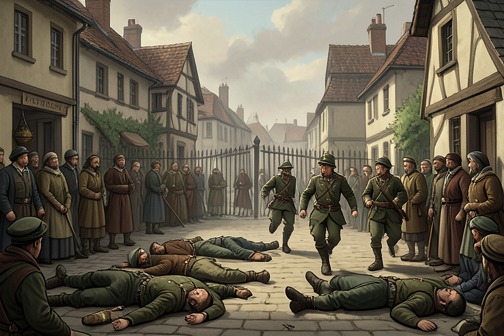
The soldiers had attended a feast in a nearby village. The account gives a specific motive for the attack: drunken peasants had become jealous of the soldiers’ relationships with local women. The attackers outnumbered and disarmed the soldiers, turning a social occasion into a lethal assault. The report establishes this motive, but does not explain the villagers’ wider circumstances or present the feast as part of an organized campaign.
## The Attack and Its Immediate Aftermath
A commotion at the camp draws the narrator outside. Mitka rushes out, pulling the narrator with him, and other soldiers run toward the guard line. There, several wounded men gather around four motionless bodies. Their fragmented account identifies the attackers as peasants from the village and describes how the soldiers were overwhelmed. The deputy commander arrives with other senior officers, listens to a wounded soldier’s report, and orders the injured taken to hospital. Some are able to walk only slowly, supporting one another as they go.
The dead include Vanka and Lonka, along with two soldiers whose faces are no longer readily recognizable to those present. Mitka crouches near the bodies, staring in silence. When an ambulance arrives and the dead are taken away, he grips the narrator’s arm in anger. [The narrator](entity:character-recall-character-1ef2797e1434)’s view of the event is shaped by this close, immediate scene at the guard line: the report of the attack is followed not by an abstract account of casualties, but by the assembled soldiers’ encounter with the dead and wounded.
## Military Response and Consequences
That evening, the attack is included in the regiment’s report. The men listen as new orders prohibit contact with the hostile local population and forbid actions that could further worsen relations with the Red Army. The directive converts the assault into a matter of military policy: beyond punishing or treating the immediate casualties, the regiment seeks to prevent further confrontation. The account does not describe a subsequent reprisal or identify what happened to the attackers.
## Mitka and the Event’s Significance
The deaths have a distinct aftermath for Mitka. That night he mutters to himself, strikes his head with his fist, and then sits in brooding silence. In the following days, regimental life resumes: the men speak less often of the dead, sing again, and prepare for a field theater. Mitka, however, remains unwell, and someone else takes over his training duties. The contrast between the regiment’s return to routine and Mitka’s continued distress makes the attack more than a reportable breach of order. It shows how violence persists in the reactions of those who survive it, even as collective life moves on.
Event 5
Mitka’s Sniper Retaliation Against the Villagers
[Mitka’s Sniper Retaliation Against the Villagers](entity:event-recall-event-197ac8686625) is a clandestine act of revenge in which [Red Army](entity:organization-recall-organization-red-army-1d37cdb1d029) sniper [Mitka](entity:character-recall-character-mitka-5a176eeef02a) uses his trained marksmanship to kill people in a village while [The boy](entity:character-recall-character-the-boy-c36ba9027348) assists from a concealed perch. The episode turns the skill and discipline of military service toward private retribution: Mitka risks his standing as a soldier and a Hero of the [Soviet Union](entity:location-recall-location-67657886d3d4) to answer, by his own measure, for friends who have died.
## Causes and Setting
The act takes place against a rural landscape already shaped by competing armed powers. In the villages where The boy has wandered, his dark features and unfamiliar speech mark him as an outsider, while the [German occupation forces](entity:organization-recall-organization-c4c65075fc94) make sheltering people identified as Jews or Roma perilous. The villagers must surrender much of their meager harvest both to regular troops and to [Partisans](entity:character-recall-character-partisans-16926068835e); refusal can bring punitive raids that leave settlements in ruins. These conditions establish a world in which survival is governed less by a single law than by whoever can enforce a demand.
Partisans themselves are divided. [White partisans](entity:organization-recall-organization-2d275b4819a5) want to fight both the Germans and the Russians, while [Red partisans](entity:organization-recall-organization-e6ead0994027) support the Red Army; their rival claims over property and land reform draw villages into their conflict. [German soldiers](entity:character-recall-character-german-soldiers-00e4e09725f6) also search the village, question peasants about partisan visits, and shoot some of them as an example. The account does not establish that the people Mitka targets personally killed his friends. It does place his retaliation in communities already caught between armed factions and military coercion, making the distinction between individual responsibility and collective exposure central to the episode’s violence.
## Secret Departure and Preparation
Several days after the regiment begins returning to ordinary routines, Mitka wakes The boy before dawn and tells him only to dress. The boy helps bind Mitka’s feet and pull on his boots, then watches him conceal his purpose: Mitka removes his rifle from its brown case, leaves the empty case locked behind the bed as if the weapon were still there, and takes the telescope, tripod, cartridges, and field glasses. He gives the field glasses to The boy, bringing him into the plan without explaining it.
They slip out past the field kitchen when the guards have marched by and cross the adjoining field toward the woods. Mitka limps, repeatedly lifting the rifle when it slips from his shoulder; he is tired and in pain, but presses on. They bypass a sleeping village and continue into the forest. The boy recognizes that Mitka is acting alone, doing something prohibited that could cost him his military position and public esteem. Yet he feels proud to have been chosen to accompany a celebrated soldier on a secret mission. His inability to speak makes that pride inward: he can hear Mitka’s curses but cannot repeat them.
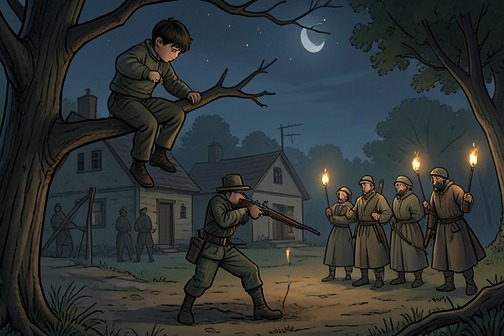
At the forest edge, Mitka selects a sturdy tree near the fields. He helps The boy climb, hands up the rifle and optical equipment, and follows him through the branches. Together they reach a high perch. Mitka bends, cuts, and ties branches to make a concealed seat, then sets the telescope on the rifle’s tripod. From there the village buildings come into view as the first smoke rises. A tall man steps out of a house; Mitka studies the scene through the telescope, keeping the binoculars beyond The boy’s reach.
## The Shooting
A shot rings out, startling The boy and sending birds fluttering through the thicket. Mitka does not let him look through the binoculars. The boy imagines the man collapsing at his threshold, then pictures an old woman finding the body and raising the alarm. People emerge from houses; men gather around the dead man, while the village fills with movement. The account distinguishes The boy’s imagined view of events on the ground from what he can actually see at their distance, but the growing panic becomes unmistakable.
Mitka keeps the rifle to his shoulder and fires three times in quick succession. The boy shuts his eyes and pictures three more bodies falling. Families drag the dead toward houses and barns; children and older people move about in confusion, and then people retreat indoors. Shutters close. Mitka surveys the village again, waiting until no one appears to be outside. When a young man tries to move between the houses and reach a hut, Mitka shoots him as well; he topples into a row of wild rosebushes. The described sequence therefore presents an initial victim, three further shots, and a final killing as the villagers withdraw into their homes.
The boy asks Mitka by gesture to shoot a dog, but Mitka refuses, looking at him with disapproval. The refusal gives the episode a boundary within its violence: Mitka has chosen his human targets as part of a deliberate reprisal, not as permission for The boy to extend the killing to an animal. Afterward they descend. Mitka buries the spent cartridges under moss and removes traces of their presence before they return to camp unnoticed.
## Private Justice and Aftermath
Back in camp, Mitka cleans the rifle and its sight and puts them away. That evening he is mild and cheerful, singing ballads about Odessa and gunners avenging mothers whose sons have died in the war. The soldiers join the chorus. From the village, funeral bells sound faintly and steadily. The contrast between the communal song and the bells makes the consequences audible without bringing the village’s dead into the camp: Mitka resumes the recognizable life of the regiment while the killings continue to reverberate elsewhere.
The boy interprets the mission as revenge for Mitka’s fallen friends, undertaken regardless of other people’s opinions and at the risk of his rank and his title as a Hero of the Soviet Union. In his understanding, military mastery would be hollow if Mitka could not act on the duty he felt toward the dead; public admiration could not settle the private judgment by which he measured himself. The episode thus sets official discipline and collective ideals beside an individual code that grants one person the authority to administer justice. The boy’s admiration is sharpened by this contrast: he sees Mitka’s solitary decision as a different kind of ascent, one reached with the help of at most a single companion rather than through the march of the masses.
The return to camp does not end the boy’s separation from Mitka. As the war ends and the country is declared liberated from the Germans, regulations require that lost children be sent to special centers while their families are sought. The boy struggles to leave Mitka, [Gavrila](entity:character-recall-character-gavrila-ed2f51729643), and his other friends; Gavrila promises to care for him if no relatives claim him within three months and to send him to school, where he can learn to speak again. In that larger transition, the secret expedition remains a moment of intense companionship—and an unsettling lesson in how a private war can survive inside an army organized around collective purpose.
Event 6
The Narrator Is Sent to the Missing Children's Center
[The Narrator Is Sent to the Missing Children's Center](entity:event-recall-event-e618b73f1ed6) marks a painful change of custody at the end of the war: the boy leaves the regiment that has become his home and enters an institution tasked with finding out whether he still has family. The transfer is presented as an administrative necessity, but its emotional force lies in the attachments and hopes it interrupts. He is sent toward his prewar city carrying gifts, books, and the uniform that makes him feel like a soldier, while the adults around him try to prepare him for an uncertain wait.
## The order to leave
[Red Army](entity:organization-recall-organization-red-army-1d37cdb1d029) mentor [Gavrila](entity:character-recall-character-gavrila-ed2f51729643) tells the boy that the war is ending, that the country has been liberated from the Germans, and that regulations require lost children to be taken to special centers until their parents’ survival can be established. The explanation makes the transfer part of a broader postwar system rather than a decision directed at the boy alone. Yet the rules turn his immediate future over to an institution and remove him from the people among whom he has learned to live.
[The boy](entity:character-recall-character-the-boy-c36ba9027348) needs several days to accept that he will leave Gavrila, Red Army sniper [Mitka](entity:character-recall-character-mitka-5a176eeef02a), and his other friends in the regiment. Gavrila is firm, but not indifferent: the boy knows that Gavrila and Mitka have discussed what should happen to him and would have chosen another solution if one had been available. Their concern does not cancel the separation; it makes clear that it has been considered and that, under the circumstances, they see no alternative.
Gavrila offers a conditional promise that gives the boy a future to hold on to. If no relatives claim him within three months after the war ends, Gavrila will take care of him and send him to a school where he can be taught to speak again. The promise recognizes both the possibility of family recovery and the boy’s continuing inability to speak. For now, however, care is deferred: first he must go to the center and wait to learn whether anyone will come for him.
## The parting and the journey
Before the departure, soldiers give the boy a bag of presents, and Gavrila and Mitka give him books. A regimental tailor has made him a [Soviet Uniform](entity:object-recall-object-e56880caa97b), and in one pocket he finds a small wooden pistol bearing Stalin’s image on one side and Lenin’s on the other. These objects make the farewell tangible. They also send him away with signs of the life he is leaving, rather than with the ordinary belongings of a child being placed in care.
Sergeant Yury is to accompany him to the town where the lost-children center is located. It is the country’s largest industrial city and, more personally, the place where the boy lived before the war. Gavrila checks that he has all his things and that his personal file is in order. It records the information the boy has given about his name, former home, parents, relatives, friends, and hometown: a family history reconstructed from what he can remember, assembled for officials who may be able to trace the people he has lost.
At the final farewell, Mitka pats the boy on the shoulder and urges him to uphold the Red Army’s honor. Gavrila embraces him warmly, and the other soldiers shake his hand as if he were grown. The boy wants to cry but keeps his face composed like a soldier’s boot laced tight. The effort to hold himself together shows how thoroughly the regiment’s expectations have become part of his way of facing separation, even as the people who taught him that discipline are the ones he must now leave.
The train takes two days to reach its destination. Its repeated stops at damaged signals and between stations expose the boy to a country still marked by war: bombed towns, deserted villages, abandoned military vehicles and aircraft, and ragged people asking passengers for cigarettes and food. Half-naked children stare at the passing train. At stations, crowds include soldiers, former prisoners, invalids, civilians, and blind people; nurses guide emaciated survivors in striped concentration-camp clothing. The journey therefore carries him through both the machinery of postwar transport and the visible human aftermath of the conflict.
## Arrival at the children’s home
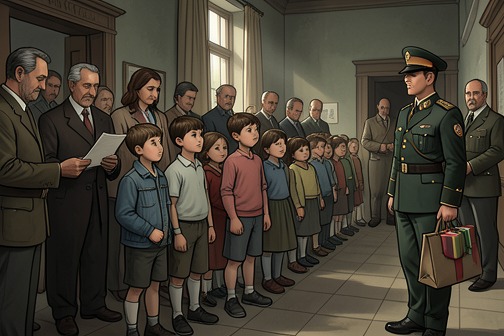
A military driver takes Yury and the boy from the station to the orphans’ home, which occupies several old houses on a side street. Children peer out of its many windows. The crowded city and the institutional building contrast with the regiment’s familiar circle of comrades: the boy has arrived at a place intended to receive children like him, but not one already shaped around his particular attachments.
Yury and the boy wait for an hour in the lobby. While Yury reads a newspaper, the boy pretends not to care. When the woman principal comes over, she takes the folder from Yury, signs papers, and places a hand on the boy’s shoulder. He firmly shakes it off. In his understanding, the epaulets on a uniform are not meant for a woman’s hands. The gesture is a small refusal of the new institution’s authority over him, expressed through the military identity he still claims.
The next farewell is between the boy and Yury. Yury acts cheerfully, jokes, straightens the boy’s forage cap, and tightens the string around the books inscribed by Mitka and Gavrila. They embrace like two men, with the principal standing nearby. At that moment the boy clutches the red star on his left breast pocket, a gift from Gavrila bearing Lenin’s profile. He believes the star that guides workers toward their goal might also bring him good luck, then follows the principal into the home.
The first signs of institutional life are not welcoming to him. Lessons are under way behind open classroom doors; children scuffle and shout in the corridors. Some boys point at his uniform and laugh, and someone throws an apple core that hits the principal after the boy ducks. The scene places him among other children without making him feel that he belongs among them. The uniform distinguishes him, but it also exposes him to ridicule.
## What the transfer leaves unresolved
In the first days, the principal wants him to exchange the uniform for ordinary civilian clothes sent by the International Red Cross. He nearly strikes a nurse when she tries to take the uniform and instead keeps his tunic and trousers folded beneath his mattress. His resistance continues the struggle begun when he shook off the principal’s hand: the transfer has changed who is responsible for him, but it has not persuaded him to relinquish the identity attached to his military clothes.
The event ends with arrival, not with the answer the boy needs. His file gathers the fragments of information he remembers, and the center is meant to determine whether his parents are still alive, but no reunion occurs in this episode. Gavrila’s three-month promise offers a possible fallback, while the boy’s faith in the red star supplies a more immediate hope. Neither can remove the uncertainty that separates the regiment he loves from the family and future he cannot yet recover.
The narrative also sets this bureaucratic passage against the destruction that preceded it. Earlier, the boy’s world included deportation trains carrying Jews and Roma, villagers watching them pass, and traces of people left along the railway. By the time he travels toward the children’s home, the war is said to be ending, yet the train journey still passes through ruined places and among survivors returning from camps. The transfer thus changes the boy’s location and guardianship without presenting postwar life as a clean break from violence or loss.
Event 7
The Narrator Is Beaten by a Farmer at the Market
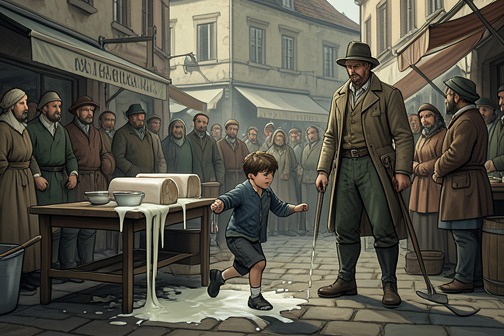
[The narrator](entity:character-recall-character-1ef2797e1434)’s assault at a local marketplace turns an accidental mishap into a public punishment, exposing how quickly a vulnerable child can become a target. The crowd’s laughter and the farmer’s violence make the narrator’s exclusion visible; the Silent One’s intervention, by contrast, establishes a practical bond of care that continues after the immediate danger has passed.
## Setting and Vulnerability
The scene takes place at a weekly market where peasants from neighboring villages sell produce and handmade goods. The narrator and the Silent One have learned to obtain small amounts of food there: an apple, a bunch of carrots, or a glass of cream, secured through smiles directed at the women selling their wares. Their method is opportunistic but modest, and the market’s abundance offers no assurance of safety. Farmers call out their goods, women try on colorful clothes, and livestock jostles through the crowded space. The two boys move among people whose attention can quickly turn from ordinary bargaining to hostility.
The assault follows a moment of distraction. Looking at a militiaman’s gleaming bicycle, the narrator stumbles against a tall dairy table and knocks it over. Milk, cream, and buttermilk spill across the market. Nothing in the account suggests a deliberate act: a brief lapse is enough to provoke a farmer, who hits the narrator before he can run. The farmer then lifts him by the scruff of his neck, continues beating him, pushes through the gathering onlookers, and puts him into an empty sauerkraut barrel, which he kicks into a garbage heap. The disproportion between the accidental spill and the punishment is central to the scene. The market’s ordinary commerce gives way to an improvised spectacle of humiliation.
The crowd does not protect the child. Its laughter accompanies the beating, and people mock the Silent One when he tries to reach him, dismissing the narrator as a stray Gypsy child. The episode therefore repeats the social logic of the narrator’s earlier encounters: an identity imposed on him makes him conspicuous, while the people around him treat his vulnerability as a reason for contempt rather than assistance. The market is not merely a setting for a private quarrel; the onlookers help make the violence public by watching, laughing, and obstructing rescue.
## The Assault and Rescue
For a moment, the narrator cannot make sense of what has happened. Disoriented by the attack and the barrel’s movement, he struggles to breathe and feels his face swelling. The farmer’s punishment has reduced him to an object to be handled and discarded. The barrel intensifies that loss of control: the narrator is trapped inside it while the crowd remains outside, able to watch and laugh.
[The Silent One](entity:character-recall-character-81b5c6382580) finds him pale and shaking, and tries to pull him free. When fear of further attacks makes a direct escape difficult, he rolls the barrel toward a water fountain with the narrator still inside. Village boys run alongside, trying to trip him and take the barrel away; the Silent One wards them off with a club. His intervention is physical and persistent, carried out while other people make rescue harder. At the fountain, the narrator crawls out soaked in water and blood, with splinters in his back and hands. The Silent One puts a shoulder under him, and the two make the painful walk back to the orphanage.
At the orphanage, a doctor treats the narrator’s cut mouth and cheek. The Silent One waits outside the room rather than leaving after bringing him to safety. When the doctor has gone, he studies the narrator’s injured face for a long time. The account gives no speech to explain this attention; it is conveyed through his waiting and looking. In a narrative shaped by the narrator’s repeated exposure to abandonment and hostility, those actions make care legible without requiring verbal reassurance.
## Aftermath and Narrative Significance
The marketplace episode sits against the narrator’s memories of people transported toward death. In earlier scenes, villagers watched trains carrying Jewish and Romani prisoners pass through the forest; some waved at the trains, while later the narrator encountered evidence of people who had fallen or been thrown from them. He had also held human ash in his hand and imagined the dead continuing to watch the living. These experiences form part of the emotional context for his thoughts about the power to decide whether unknown people live or die. The market assault brings that large, impersonal power down to a local scale: here, a farmer’s anger and a crowd’s complicity determine what happens to one child in their midst.
The contrast is not that the farmer and the perpetrators of mass violence are equivalent, but that the episode continues the book’s attention to how power operates through ordinary people and immediate acts. The narrator is exposed to the farmer’s force and the crowd’s indifference; the Silent One uses what agency he has to carry him out of danger. The scene thus places cruelty and protection side by side without allowing the rescue to erase the humiliation or the injury.
Two weeks later, the Silent One wakes the narrator at dawn. Dust covers him, his shirt clings to his perspiring body, and he signals for the boy to follow. The narrator gathers that the older boy has been out all night, but does not know what he intends. This summons follows the market assault and the Silent One’s sustained care, while opening onto a new episode whose purpose is not yet clear. The sequence ends not with an explanation, but with a changed relation: after bringing the narrator back from the market, the Silent One now leads him somewhere in silence.
Event 8
The Market-Day Train Derailment
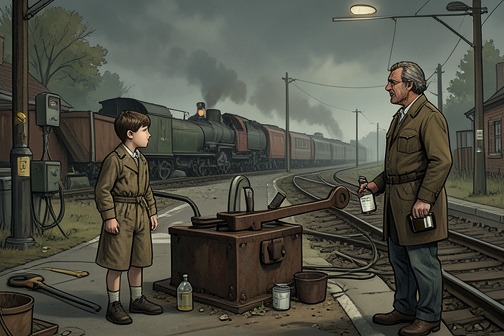
[The Market-Day Train Derailment](entity:event-recall-event-451f06bdbdce) is the turning point in which the Silent One converts a secret railway mechanism into a means of mass violence. [The unnamed boy narrator](entity:character-recall-character-905a426e9322) watches beside him as a crowded train crashes, then learns that the man who had attacked him survived. The episode joins private grievance to the larger history of trains carrying people toward death, while leaving the Silent One’s purpose and the disaster’s human cost only partly known.
## The Crossing and the Secret
The episode’s groundwork lies at a crossing a few miles from the city, where a railway spur begun before the war had never been completed. Its rusty points were overgrown with moss, and the line ended short of a cliff where a bridge had been planned. The boys had inspected the mechanism and tried to shift it, but the lever would not move. This abandoned infrastructure seemed inert, but it contained the capacity to redirect a train.
[The Silent One](entity:character-recall-character-81b5c6382580) discovered how to free the mechanism after watching a locksmith open a jammed lock with oil. The next day, he stole a bottle of oil from the kitchen. The boys poured it over the switch’s bearings, waited for it to work into the mechanism, and then hung their weight on the lever. It moved with a jolt, sending the points onto the other track. Startled by their success, they immediately switched it back. Their knowledge remained a secret between them, but the narrator began to imagine that a single movement could send a train over the cliff. That fantasy gives the disaster a clear practical precondition without establishing what the Silent One intended when he later returned to the switch.
## The Morning Train
Two weeks after the narrator was injured in a market attack, the Silent One woke him before dawn. Dust covered him, his shirt clung to his perspiring body, and he signaled for the narrator to follow. He led him to a derelict hut near the crossing. From its roof, they waited for a train. [The narrator](entity:character-recall-character-1ef2797e1434) did not know what the Silent One had planned.
The train appeared at sunrise on market day, when peasants from nearby villages were traveling to market. Its carriages were crowded; baskets protruded from the windows, and passengers clung to the steps. As it approached the crossing, the Silent One moved close and gripped the narrator’s arm. The locomotive veered aside, while only the first two cars followed it. The remaining carriages lurched off the embankment and crashed together. Steam obscured the scene, and cries rose from below. The narrator was stunned. The Silent One sagged, then pulled him away, and they hurried back to the orphanage as people rushed toward the wreck and ambulance bells sounded nearby.
## Public Aftermath and Private Recognition
At the orphanage, everyone was still asleep. The narrator saw no tension in the Silent One’s face; he smiled softly. In the days that followed, newspapers printed the names of the dead, and cranes lifted the twisted carriages from the track. Police searched for political saboteurs, suspected of earlier crimes. The account does not state a casualty total or identify the passengers individually, so the disaster’s scale is conveyed through the crowded train, the lists of names, and the wreckage rather than a definitive count.
On the next market day, the Silent One hurried the narrator through the crowd to the stand belonging to the man who had knocked out the narrator’s teeth and pushed him into a barrel. The stand remained in place, stocked with milk, cream, butter, and fruit; its owner was alive. The narrator looked at the Silent One in anguish. The Silent One stared at the man in disbelief, took the narrator’s hand, and led him away. Once they reached the road, he fell onto the grass and cried. It was the only time the narrator had heard his voice. The surviving tormentor makes the outcome more complicated than a completed act of personal revenge: the train has been destroyed, yet the apparent intended target remains unharmed. The Silent One’s reaction suggests the importance of that failure, but the narration does not explain his plan in words.
## The Railway’s Reversed Meaning
The crossing recalls the earlier trains carrying Jews and Roma toward camps. The villagers had watched deportation trains pass, sometimes waving to the people inside; the narrator had also encountered the traces left along the tracks. Those episodes make the railway more than a convenient setting. It is a route by which people in power can determine the fate of strangers, whether by sending them toward death or, in this case, by diverting a train into disaster.
Before the derailment, the narrator had imagined that the lives of everyone aboard lay in his hands, and compared this power to that of those who ordered mass roundups and decided where trains would go. The market-day wreck brings that disturbing analogy into action. The boys’ secret, their access to the lever, and the crash show how quickly imagined control becomes consequential violence. Yet the episode does not make the boys’ power absolute: the man whose survival matters to the Silent One is still at his stand the following market day. The wreck therefore binds together a secret act, public catastrophe, and failed private vengeance without resolving what the Silent One hoped the derailment would accomplish.
Event 9
The Narrator Reunites with His Birth Parents
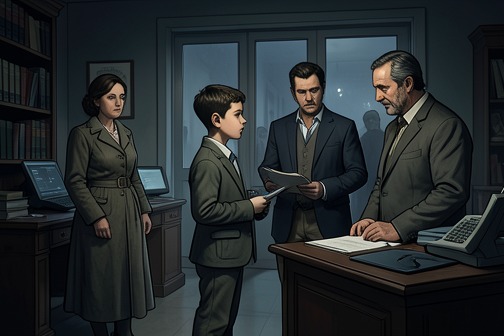
[The Narrator Reunites with His Birth Parents](entity:event-recall-event-b8080a30d882) is a turning point in which the unnamed boy narrator is identified and reclaimed by his family, yet reunion does not restore a simple sense of home. A birthmark confirms who he is; leaving the orphanage brings him into his parents’ care and into a changed family, but he remains attached to the independence and imagined future built during his years apart from them. The scene makes recognition a beginning rather than a resolution: he is found, but still does not know how to belong.
## The search and the meeting
Early one morning, a teacher summons the boy to the principal’s office. He initially wonders whether the news concerns [Red Army](entity:organization-recall-organization-red-army-1d37cdb1d029) mentor [Gavrila](entity:character-recall-character-gavrila-ed2f51729643), then grows uncertain as he approaches. The principal is there with a member of the Social Commission, the official who believes he knew the boy’s parents before the war. Their cordial greeting cannot conceal their nervousness, and voices from an adjoining room signal that the meeting has been prepared in advance.
The commission member opens the door to a man and a woman. [The boy](entity:character-recall-character-the-boy-c36ba9027348) finds their faces strikingly familiar and recognizes that they could be his parents, but he does not immediately acknowledge that possibility. Beneath the star on his uniform, he can feel his heart beating; he grips his chair and weighs whether to reveal recognition or feign indifference. The pause matters because the reunion is not simply a discovery made for him. He understands that accepting it will alter his life, and for a moment he still has a choice about how to answer.
The woman bends toward him in tears, while the man, visibly shaken, supports her and tries to compose himself. He speaks Russian fluently and asks the boy to unbutton his uniform so that they can look for a birthmark on the left side of his chest. The boy knows it is there. He hesitates, aware that showing it will remove any doubt, but the woman’s distress moves him to open his uniform. The birthmark confirms his identity; his parents embrace and kiss him, and the reunion becomes undeniable.
## Recognition and reluctance
Confirmation does not make the boy’s feelings uncomplicated. He recalls that Red Army mentor Gavrila had told him parents had a right to their children, and he knows he is only twelve and not yet grown. To him, that principle turns the meeting into more than an emotional recognition: once the birthmark settles who he is, he believes his parents must take him away, whether or not they wish to. The obligation of family arrives at the same instant as its affection.
He studies the pair and judges them frail and unwell rather than threatening. Yet the tenderness of their response does not erase his hesitation. He knows he could run away, board one of the crowded trains, and disappear beyond their reach. He also wants Red Army mentor Gavrila to find him, so staying where he can be found seems wiser than escape. His decision is therefore divided: he allows the reunion to proceed, but his hoped-for future still belongs partly to the world he associates with Gavrila and [Mitka the Cuckoo](entity:character-recall-character-mitka-a30bc99b673d).
That imagined future has specific stakes. Rejoining his parents means giving up his dream of becoming an inventor of fuses that could change people’s color and of working in the land of Red Army mentor Gavrila and Mitka the Cuckoo, where, in his imagination, tomorrow has already arrived. The vision combines invention, a different political world, and a future he has chosen for himself. The parents’ return does not disprove that vision; it places it in conflict with a life organized around family, care, and obedience.
## Leaving the orphanage
When the boy’s father returns, both parents embrace him, look him over, and exchange comments about him. The family prepares to leave the orphanage and goes to say goodbye to [The Silent One](entity:character-recall-character-81b5c6382580). He watches the parents warily, shakes his head, and refuses to greet them. His refusal leaves the boy’s old connection present at the threshold of the new one: the reunion does not draw every person in the orphanage into the family’s circle, nor does it make the boy’s previous world disappear.
Outside, the father carries some of the boy’s books. Their departure takes place amid postwar disorder: ragged, exhausted people carrying sacks are returning home and disputing with those who occupied their homes during the war. The boy walks between his parents, aware of their hands on his shoulders and hair, but experiences their protection as smothering. The detail complicates the expected comfort of being recovered. Their touch communicates care, while its closeness makes the world around him feel newly constricted.
The parents take him to an apartment they have managed to borrow with difficulty after hearing that a boy matching their son’s description was at the local center. There he discovers that they have another child, a four-year-old orphan whose parents and older sister were killed. An old nurse saved the child and handed him to the father during the family’s wanderings in the third year of the war; the parents adopted him and clearly love him. The reunion thus reveals that the family has changed during the separation: the boy returns not to an unchanged household, but to one in which another bereaved child has already been made a son.
## An unresolved return
The adopted child’s presence deepens the boy’s uncertainty rather than settling it. He wonders whether it would be better to remain alone and wait for Red Army mentor Gavrila, who might eventually adopt him. Wandering without knowing what would happen next seems preferable to a home where the future appears predictable. His response is not evidence that his parents reject him; he sees their affection. Instead, their care confronts him with a form of belonging that entails dependence and a changed identity as someone’s real son.
The event closes on this tension, not on a declaration of reconciliation. The boy has been identified, embraced, and taken from the orphanage, but he cannot readily accept that he must now be cared for and obey his parents because they are his parents. The reunion restores a factual family relationship while leaving its emotional meaning unsettled. Its decisive consequence is therefore double: the separation ends in practical terms, but the boy’s desire for freedom and chosen direction survives inside the newly reunited family.
Event 10
The End of the War in Europe
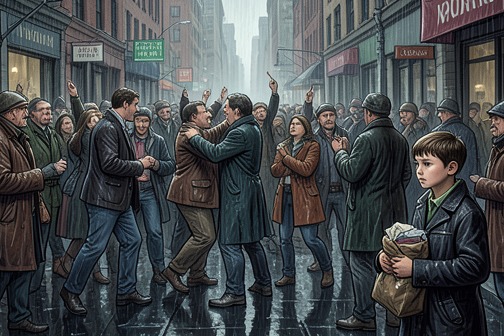
[The End of the War in Europe](entity:event-recall-event-5ecc526f74a1) is announced in the city on a rainy day in May, when people dance and embrace in the streets. For the narrator, however, the announcement does not end separation or restore the life he has lost. The war’s conclusion brings a new administrative reality: he must leave the [Red Army](entity:organization-recall-organization-red-army-1d37cdb1d029) friends who have cared for him and wait to learn whether his family is alive. The celebration and the uncertainty begin together.
## Wartime Conditions
The announcement follows years in which ordinary life was governed by competing threats. In the villages where the narrator had been stranded, the [German occupation forces](entity:organization-recall-organization-c4c65075fc94) made sheltering a Jewish or Romani child dangerous for individuals and communities. Peasants also had to surrender much of their meager harvest to German troops and [Partisans](entity:character-recall-character-partisans-16926068835e); refusal could bring punitive raids and leave settlements in ruins. The end of the war closes this period of occupation, but the narrator’s experience has been shaped by systems that repeatedly made safety conditional.
The danger was not confined to military encounters. [The narrator](entity:character-recall-character-1ef2797e1434) had seen the locked trains carrying Jewish and Romani people toward death, while villagers watched them pass. These scenes form part of the world the May announcement is supposed to leave behind. They also make the distinction between the end of fighting and the end of its human consequences especially stark: the news changes the political situation, but it does not undo loss, fear, or the narrator’s displacement.
## The Announcement and Its Immediate Meaning
The news reaches the city in spring. People respond with dancing, kissing, and embraces, while that same evening ambulances collect people injured in brawls at drinking parties. The public mood is therefore not presented as unbroken rejoicing. Celebration coexists with violence, and the streets register both relief and the disorder still carried into the peace.
For the narrator, the decisive consequence is separation from his regiment. [Gavrila](entity:character-recall-character-gavrila-ed2f51729643) tells him that the war is over and that his country has been fully liberated from the Germans. Under the applicable regulations, lost children must be taken to special centers and kept there while officials determine whether their parents are alive. The rule turns liberation into a forced transition: the boy cannot simply remain with the people who have become his companions, even though their care is familiar and his future with them is uncertain.
## Separation and the Promise of Care
The narrator takes several days to accept that he must leave Gavrila, Red Army sniper [Mitka](entity:character-recall-character-mitka-5a176eeef02a), and the other friends he has made in the regiment. Gavrila is firm that the regulations must be followed, but he is not indifferent to the child’s distress. The narrator sees that Gavrila is uneasy too, and understands that he and Red Army sniper Mitka have discussed his future and would have chosen another solution if one were available.
Gavrila offers a conditional promise: if no relatives claim the narrator within three months after the war’s end, he will take care of him and send him to a school where he can learn to speak again. Until then, he urges the boy to be brave, remember what he has learned, and read [Pravda](entity:object-recall-object-c0c5bddd3096) every day. The offer gives the separation a limit and a possible future, but it cannot remove the immediate uncertainty. The narrator must leave now without knowing whether his family will return or whether Gavrila’s promise will be needed.
## Peace Without Return
The narrator later searches the newspapers for news and visits the orphanage hoping to find a letter from Gavrila or Red Army sniper Mitka; none comes. He learns that not all armies are due to return home and that [Germany](entity:location-recall-location-a3c24dd56e42) is to remain occupied, perhaps for years. The end of the war thus does not mean that his wartime friends can promptly come back to him. The promised reunion remains suspended by the continuing military settlement.
The city itself offers no simple refuge. People arrive in large numbers from across the country, hoping to find work and recover what they have lost, but many cannot secure either employment or living quarters. Crowded streets, competition for transport and places in restaurants, and short tempers make postwar life another struggle over limited space and resources. The narrator’s account sets the celebratory announcement against this unsettled aftermath: war has ended as a formal condition, while displacement, separation, and the habits of conflict persist.
Event 11
The Narrator Regains Speech After a Skiing Accident
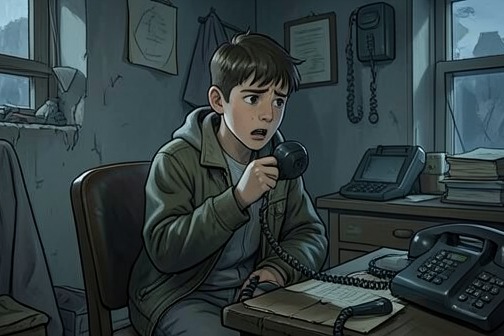
[The narrator](entity:character-recall-character-1ef2797e1434)’s recovery of speech follows a dangerous descent in a blizzard and ends a period in which his voice had been absent. The change arrives not through a stated medical explanation but in an ordinary room, when a telephone keeps ringing and someone on the other end wants to talk. The narrative makes speech return as effort, sound, and astonished repetition: first a strained attempt at syllables, then sentences and songs spoken aloud.
## Mountain Isolation and the Accident
The episode begins in the mountains because the narrator is too thin and not growing. Doctors recommend mountain air and exercise, while his teachers consider the city unsuitable for him. His father takes work in the western hills, and when the first snows come the boy is sent to live with an old ski instructor in the [Mountain shelter](entity:location-recall-location-2176108e0193). His parents see him only once a week. This arrangement places the accident within a period of separation from family and ordinary city life, rather than presenting it as an isolated mishap.
The instructor provides a daily routine: they rise early, and the instructor kneels to pray while the narrator watches. [The boy](entity:character-recall-character-the-boy-c36ba9027348) interprets this adult’s faith as a failure to accept that people are alone and cannot rely on assistance. His bleak conviction that each person stands apart gives the surrounding landscape a double meaning. The narrator spends his days skiing long trails through deserted hills, where hostels have burned and the former valley inhabitants have been sent away; new settlers are only beginning to arrive. The physical emptiness of the mountains echoes his sense of human separation.
The blizzard abruptly turns that setting from a place for exercise into a source of danger. Snow swirls across the peaks and ridges, and the narrator loses sight of the instructor. He starts down the steep slope alone, trying to reach the shelter quickly. His skis bounce over hardened, icy snow, and the speed takes his breath away. When a deep gully comes into view, he is already too late to turn. The account establishes the immediate sequence and peril but does not describe the collision, the extent of his injuries, or a medical explanation for his later recovery of speech.
## The Telephone and the Return of Speech
The next scene is set in April, in a room filled with sunshine. The narrator moves his head and finds that it no longer seems to hurt; as he starts to lift himself on his hands, the telephone rings. The nurse has already left, but the ringing continues insistently. The contrast is striking: after the mountain’s blinding storm and the danger of the gully, the turning point takes place in a quiet interior, through a routine device and a voice carried along a wire.
The narrator pulls himself out of bed and walks to the table to answer. He hears a man speaking impatiently. The man’s identity and words are not supplied, and the importance of the call lies less in its content than in the fact that someone at the other end wants to speak with him. That contact awakens an overpowering desire in the narrator to answer. The sequence moves from hearing another person to wanting a voice of his own, without claiming that the caller knows anything about his condition.
Speaking does not happen effortlessly. The narrator opens his mouth and strains; sounds crawl up his throat, and he concentrates on arranging them into syllables and words. He distinctly hears them emerge one after another, compared in the account to peas falling from a split pod. The comparison gives the return a physical rhythm: language is not merely recovered as an abstract ability but released in separate sounds that he can hear. He puts the receiver aside, scarcely believing what has happened, and begins to recite words, sentences, and snatches of [Red Army](entity:organization-recall-organization-red-army-1d37cdb1d029) sniper [Mitka](entity:character-recall-character-mitka-5a176eeef02a)’s songs.
## Voice, Memory, and the Ending
Once speech begins, it gathers momentum. The narrator talks loudly and continuously, first like the peasants and then like city people, as fast as he can. His attention is fixed on the sounds and their weight of meaning, and he repeatedly convinces himself that speech now belongs to him and will not escape through the balcony door. This is both a declaration of change and an expression of its precariousness: he has regained the ability to speak, but the scene shows him testing and reaffirming that ability rather than treating it as an unremarkable fact.
The remembered songs connect this new voice to material carried from earlier experience. The narrator describes the voice lost in a faraway village church as having found him again and filled the room. The image does not explain how or why speech returns; it gives the event an emotional shape, joining present utterance to a distant past. In the final movement, the room becomes full of speech as the narrator moves between remembered registers and tests words at increasing speed.
The episode’s structure makes the recovery legible through contrast: a storm that erases the instructor from view is followed by a voice arriving over a telephone line; a silent or absent voice becomes a stream of audible language. Yet the narrative leaves the physical consequences of the ski accident and the cause of the speechlessness unspecified. Its emphasis falls instead on the experience of speaking again: the strain in the throat, the sequence of sounds, the remembered songs, and the narrator’s insistence that the voice will stay. Speech returns not as a general explanation of what has happened to him, but as an event he can hear himself perform.